Autism Evaluations
Comprehensive Testing with a Certified Autism Clinical Specialist
Free 15-Minute ConsultationAutism is a developmental and neurological condition that affects how people communicate with others, learn, and behave. Autism is a spectrum, meaning symptoms vary in their type and severity. Put another way, no two people with autism have the exact same presentation.
For adults questioning if they may be on the spectrum, a psychological evaluation can be life changing. If you are having difficulties communicating effectively with others, have restricted interests and repetitive behaviors, fear changes, or have challenges with transitions, I truly hope you will consider a free consultation.
TERMS: Today, the field has moved away from the pathologizing term "disorder" and many autistics believe autism is not a disease or disorder. There is still some debate over person-first vs. identity-first language. Other medical model terms, such as "high-functioning," are considered outdated labels and not commonly used. Many times, autism spectrum has been misdiagnosed as obsessive-compulsive disorder, severe social anxiety, bipolar disorder, ADHD (which is in the same class of neurodevelopmental disorders), and even schizophrenia.
AUTISM SPECTRUM MEASURES: A BRIEF HISTORY: Many autism measures currently in use today, including the ADOS and ADI-R, were originally released in 1989 and 1994, respectively. This means that there are entire generations of people that may have missed the opportunity for diagnosis before these instruments were widely used.
My office uses the MIGDAS-2, which was published in 2018. It is a flexible, sensory-based instrument that characterizes a person's communication style and sensory experience through a structured clinical interview. This approach is particularly well-suited to adults and to individuals with strong adaptive skills, for whom observation-based measures can under-identify autism, and it streamlines the diagnostic process for both males and females, regardless of educational history.
WHAT TO EXPECT AT AN EVALUATION: Autism tests are not primarily focused on cognitive assessment, unless this is part of the presenting concern (job difficulties, accommodations, etc.). Instead, you will answer questions in structured clinical interviews, self-report forms on an iPad, paper-and-pencil measures, and review important medical and clinical history.
You can expect to receive your results in two weeks, where you will receive recommendations and next steps that may involve social group supports, individual therapy supports, academic or job accommodations, or more.
Most adult clients bring a person that knew them during childhood to the evaluation, although this is not necessary. Many clients bring a family member, friend, counselor, teacher, or coach. Some people have arranged their person call the office at the time of the MIGDAS-2, especially for people living out of state.
The assessment lasts 4-5 hours in total with breaks provided.
Autism Testing Offered For Clients Age 8 Years and Older
⚡ Immediate Availability
Choice of tele-assessment or in-person evaluation. Home evaluations require a computer with camera. While other clinics have 6+ month waitlists for autism assessments, we offer appointments within days. Confidential evaluations.
📋 Complete in 2 Weeks
From your first appointment to receiving your comprehensive report—just 14 days. We understand the urgency of getting answers.
🎯 Specialized Expertise
As a practicing clinician who believes in the neurodiversity paradigm, autistic differences are simply part of human biodiversity. I'm a Certified Autism Clinical Specialist with over 40 continuing education hours devoted to autism assessment and research.
📱 Responsive Communication
Questions answered within 24 hours during business hours. Your mental health is too important to be kept waiting for next steps.
🏆 Award-Winning Care
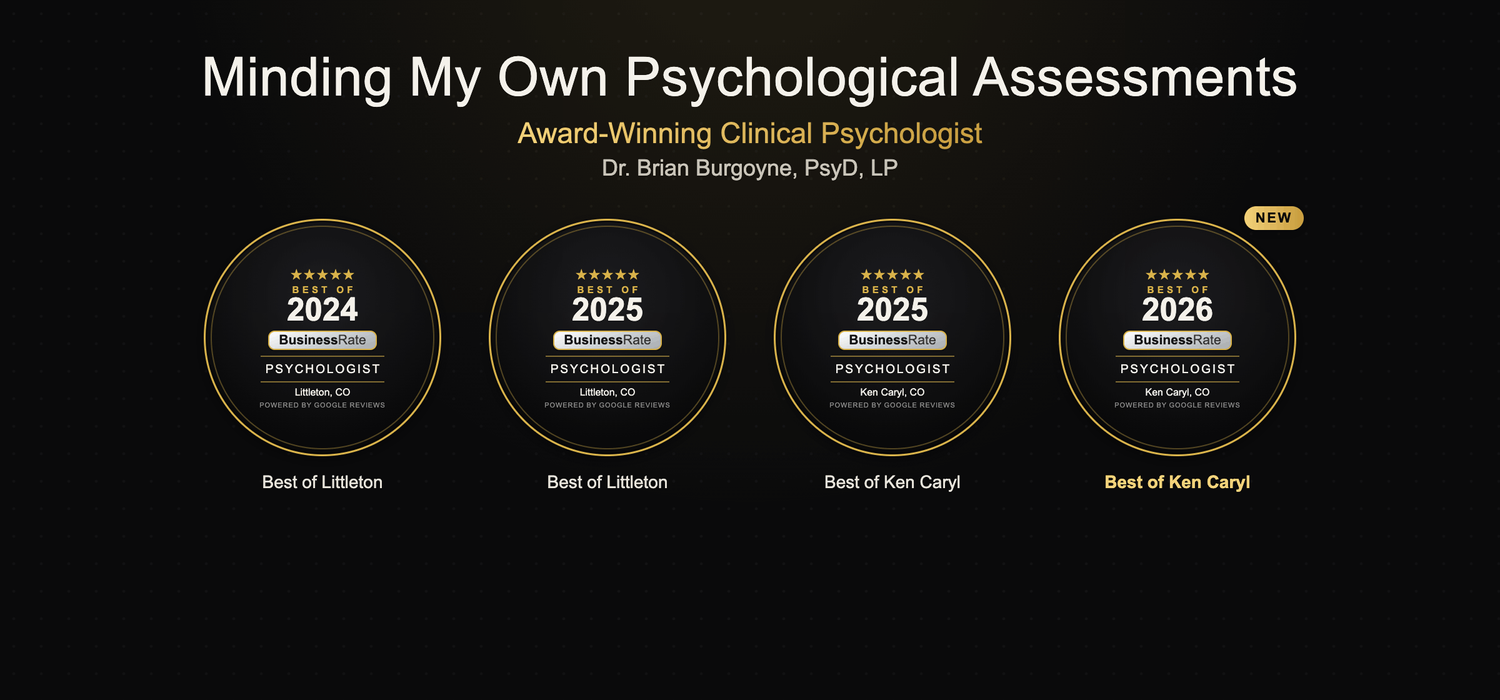
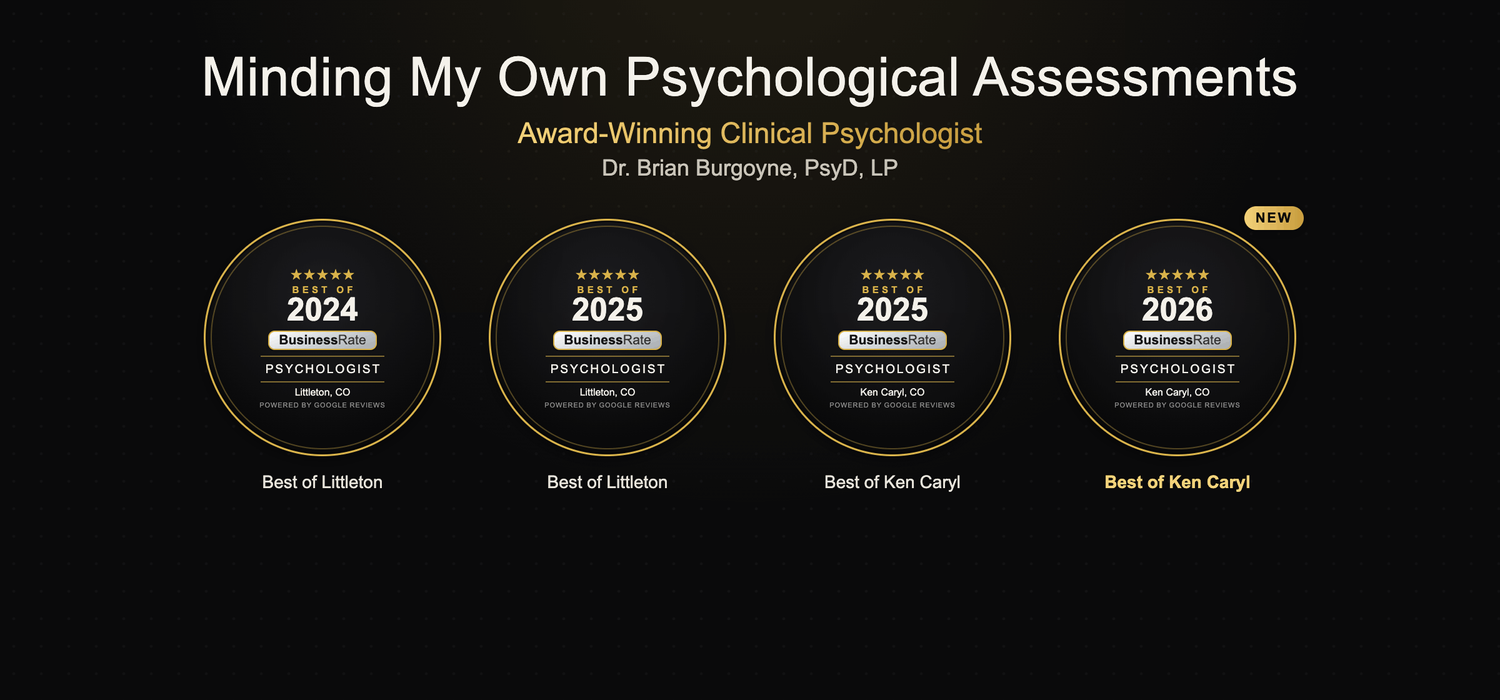
You can expect a neurodiverse-affirming evaluation and feedback session. Best of Littleton Clinical Psychologist 2024 & 2025. Recognition you can trust for an accurate, compassionate evaluation.
💰 Insurance-Friendly
We provide insurance verification and detailed superbills for reimbursement. Making quality autism assessment accessible.
Understanding Autism Spectrum Differences
Autism Spectrum (ASD) is a neurodevelopmental condition affecting social communication, sensory processing, and behavioral patterns. It's called a "spectrum" because it presents differently in each person—from subtle social differences to more significant support needs.
Social Communication
- Difficulty with back-and-forth conversation
- Challenges reading social cues and body language
- Difficulty or lack of interest maintaining eye contact
- Literal interpretation of language
- Challenges with perspective-taking
- Difficulty making or keeping friends
- Reduced sharing of interests or emotions
Repetitive Behaviors & Interests
- Repetitive movements (hand-flapping, rocking)
- Insistence on sameness or routines
- Highly focused, intense interests
- Repetitive use of objects (lining up toys)
- Echolalia (repeating words or phrases)
- Distress with changes or transitions
Sensory Differences
- Hyper- or hypo-reactivity to sensory input
- Unusual interest in sensory aspects of environment
- Sensitivity to sounds, lights, textures, or smells
- Seeking or avoiding certain sensations
- Difficulty with clothing textures or tags
- Food texture sensitivities
Who Benefits from Autism Evaluation?
Children (Ages 8-12)
Difficulty making friends, unusual play patterns, language differences, repetitive behaviors, sensory sensitivities, school social challenges.
Teens (Ages 13-17)
Social anxiety, feeling "different," struggles with peer relationships, need for school accommodations, bullying concerns, preparing for adulthood.
College Students
Overwhelming social demands, difficulty with dorm life or roommates, need for academic accommodations, understanding social expectations, career planning.
Adults
Finally seeking answers for lifelong differences, workplace challenges, relationship difficulties, burnout from "masking," need for self-understanding and validation.
Our Autism Evaluation Process
A comprehensive, evidence-based assessment using research-validated diagnostic tools.
1. Free 15-Minute Consultation
We discuss your concerns, answer questions about autism assessment, and determine if testing is appropriate. No pressure, just information.
2. Developmental History Interview (90-120 minutes)
Comprehensive discussion of developmental milestones, social history, behavioral patterns, sensory experiences, and current functioning across settings.
3. Standardized Assessment (3-5 hours)
Research-validated measures including MIGDAS-2 (Monteiro Interview Guidelines for Diagnosing the Autism Spectrum), cognitive assessment, and adaptive functioning measures. We use the most current, evidence-based tools.
4. Parent/Teacher Rating Scales
Standardized questionnaires completed by those who know the individual well, providing information about behavior across different settings.
5. Differential Diagnosis Analysis
We carefully consider and rule out other conditions that can present similarly (ADHD, anxiety, social communication disorder, sensory processing issues, etc.).
6. Comprehensive Report & Feedback (60-90 minutes)
Detailed findings, clear diagnosis (or explanation if autism is not present), level of support needs, specific recommendations for interventions, accommodations, and next steps. You receive your report the same day.
What Your Autism Evaluation Includes
Clear Diagnostic Clarity
Definitive answers about whether autism spectrum is present, what level of support is needed (Level 1, 2, or 3), and how it impacts daily functioning.
Evidence-Based Assessment
We use MIGDAS-2 (Monteiro Interview Guidelines for Diagnosing the Autism Spectrum) and other research-validated measures for comprehensive autism evaluation.
Differential Diagnosis
Comprehensive evaluation ruling out conditions that can present similarly: social anxiety, ADHD, attachment disorders, language disorders, and trauma-related symptoms.
School & Workplace Accommodations
Documentation accepted for IEP/504 plans, college disability services, workplace accommodations under ADA, and vocational rehabilitation services.
Treatment & Support Roadmap
Specific recommendations for therapies (social skills training, occupational therapy, speech therapy), educational interventions, and community resources.
Strengths-Based Approach
We identify not just challenges but also cognitive strengths, special interests, and unique abilities that can be leveraged for success.
Meet Dr. Brian Burgoyne, PsyD, LP
Best of Littleton Clinical Psychologist 2024 & 2025
Dr. Burgoyne is a licensed clinical psychologist and Certified Autism Clinical Specialist specializing in autism spectrum evaluation using research-validated diagnostic tools including MIGDAS-2. He has completed over 500 comprehensive psychological assessments since 2023, with extensive experience evaluating autism across the lifespan—from children to older adults.
His autism evaluations are thorough, compassionate, and neurodiversity-affirming. Families appreciate his clear communication, quick turnaround time, and ability to answer questions with patience and expertise. He serves clients ages 8-89 throughout the Denver metro area.
Frequently Asked Questions
How long does autism evaluation take?
The entire process—from initial consultation to receiving your comprehensive report—takes approximately 2 weeks. The testing sessions typically span 4-5 hours total with breaks provided (may be split across multiple appointments for children).
Can adults be evaluated for autism?
Absolutely. We evaluate adults ages 18-89. Many adults seek autism assessment after realizing they've been masking autistic traits their entire lives, or after their child receives an autism diagnosis.
What if my child was already diagnosed with ADHD?
Autism and ADHD commonly co-occur. Our comprehensive evaluation can determine if both conditions are present and how they interact, leading to more targeted support strategies.
What assessment tools do you use?
We use MIGDAS-2 (Monteiro Interview Guidelines for Diagnosing the Autism Spectrum) along with other research-validated measures for comprehensive autism assessment. We selected the MIGDAS-2 because it is particularly well-suited to adults and individuals with strong masking and adaptive skills, where traditional observation-based measures can under-identify autism.
What if testing shows it's NOT autism?
Our comprehensive assessment evaluates multiple conditions. If autism is not present, we'll identify what is actually causing the difficulties (ADHD, anxiety, social communication disorder, sensory processing issues, etc.) and provide appropriate recommendations.
Will this report be accepted for school accommodations?
Yes. Our comprehensive reports meet requirements for IEP and 504 plans, college disability services, and workplace accommodations under the ADA.
Do you take insurance?
We provide insurance verification and detailed superbills for out-of-network reimbursement. Many clients receive 50-80% reimbursement from their insurance company.
Request An Online Appointment From the Home Page Or Call Below to Schedule
No waitlist. Comprehensive autism assessment. Results in 2 weeks.
Serving the greater Denver Metro Area
Call to Schedule Your Free ConsultationAges 8-89 | MIGDAS-2 Assessment | In-Person & Telehealth Options